

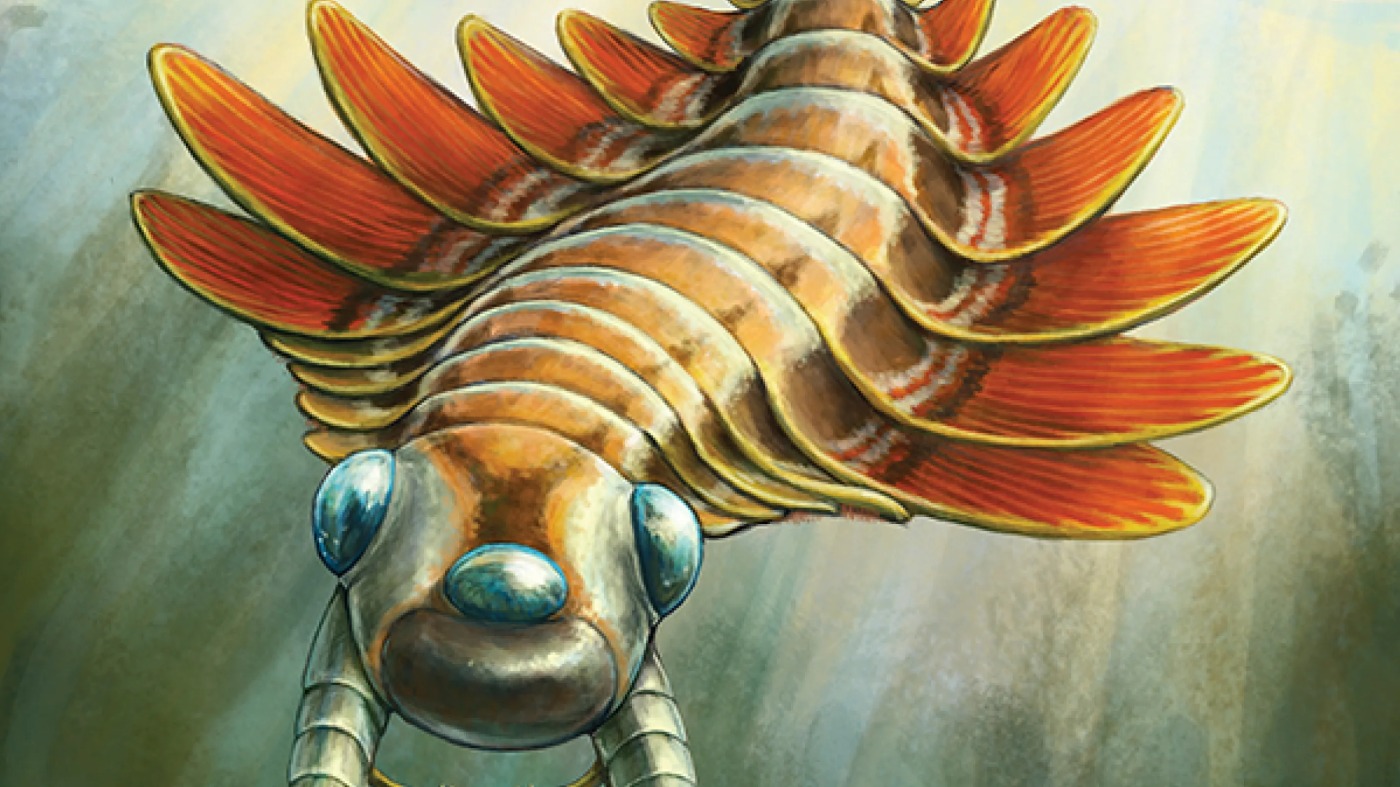
A reconstruction of Mosura fentoni, an extinct sea creature from greater than 500 million years in the past.
Danielle Dufault/Royal Ontario Museum
conceal caption
toggle caption
Danielle Dufault/Royal Ontario Museum
Paleontologists have found a three-eyed creature with a pencil sharpener-like mouth that roamed the ocean for prey greater than 500 million years in the past.
The fossilized stays of 1 Mosura fentoni — nicknamed the “sea moth” — had been discovered within the Burgess Shale of Canadian Rockies, presenting researchers with new perception into animal life within the Cambrian interval, in response to a paper revealed this week within the journal Royal Society Open Science.
The predator was in regards to the size of an index finger, with three eyes dotting its head and a round mouth lined with tooth, in response to paleontologists on the Manitoba Museum and Royal Ontario Museum who made the discovery. The beast was additionally outfitted with flaps on each side of its physique for swimming, and had intimidating claws extending from its head.
“It has a pair of those jointed claws on the entrance of its head which have these very lengthy spines on them,” stated lead research creator Joe Moysiuk, curator of paleontology and geology on the Manitoba Museum.
“It provides it virtually a little bit of an Edward Scissorhands look.”
The invention of the Mosura — a part of the extinct group, radiodonts — revealed that the creature was rather more advanced than fossils of different radiodonts beforehand recommended, in response to researchers.
Fairly than the easy abdomen-like space noticed in different radiodonts, at its rear, this creature’s physique included 16 segments lined with gills, much like trendy arthropods.
“One of many actually attention-grabbing issues about this discovery is that multi-segmented abdomen-like area of the physique of this new species, and it is one thing that we’ve not seen in any of its shut family earlier than,” Moysiuk stated. “It reveals us that these animals had been able to modifying completely different areas of their physique and specializing them for various types of features, which is one thing that we see in a variety of the residing family.”
The well-preserved fossil confirmed the Mosura’s open circulatory system, consisting of a coronary heart that pumped blood into giant physique cavities, referred to as lacunae.
The ocean moth is believed to have used its physique flaps to swim equally to trendy stingrays, sharing the waters with fellow radiodont and early apex predator, the enduring Anomalocaris canadensis.
Stewart Edie, a paleobiologist on the Smithsonian Museum of Pure Historical past, stated the invention of the Mosura provides scientists higher perception into how various life on Earth was even previous to the Cambrian explosion — throughout which advanced life started to take form.
“The Cambrian Explosion is known for organising the foundational physique plans for a lot of the main animal teams we all know at the moment — however much less clear has been how shortly or extensively evolution was continuing inside them,” Edie stated.
“The current discovery of Mosura reveals {that a} group of arthropods — one long-held to be fairly pedestrian in its evolutionary historical past in comparison with its shut family — was in on the ‘explosion,’ too.”
