

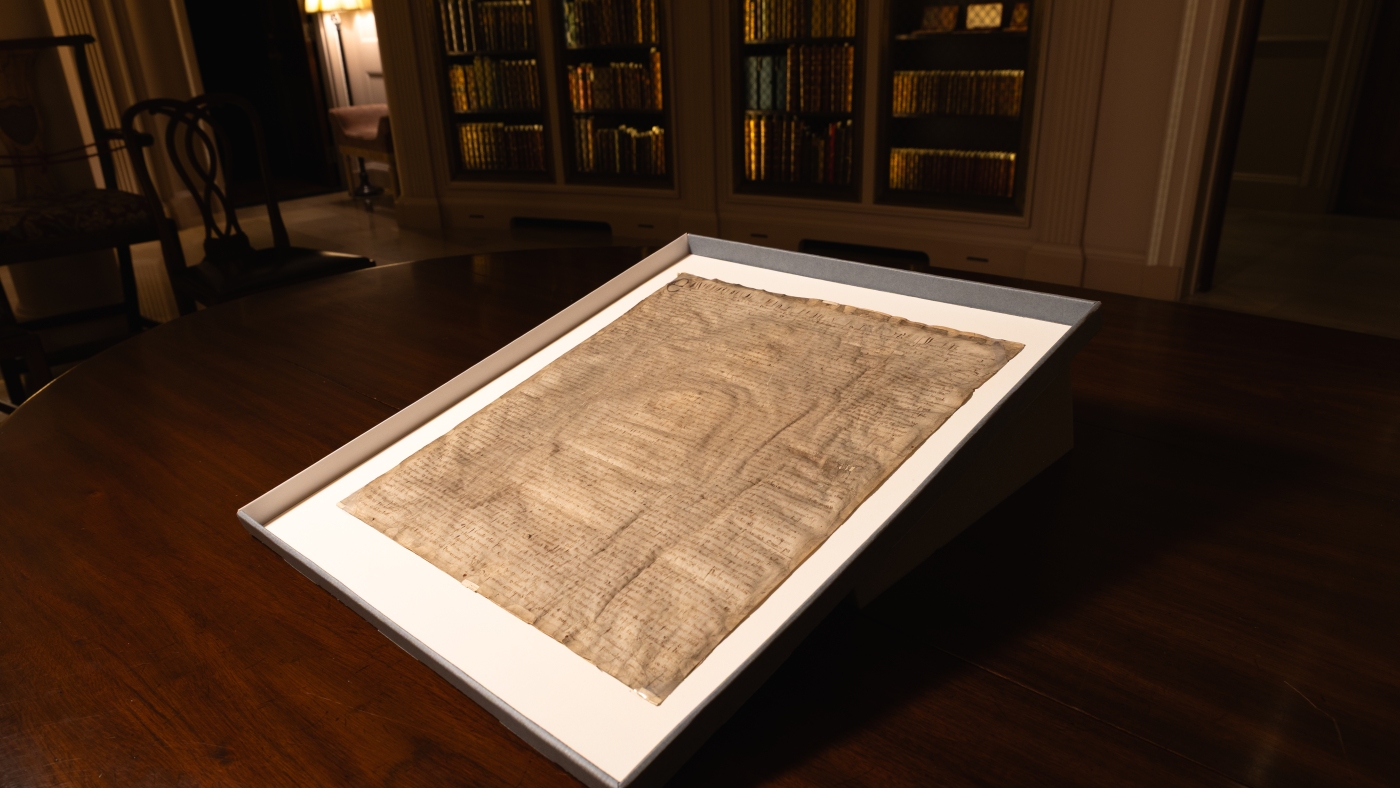
A replica of the 1300 model of the Magna Carta on show on the Harvard Regulation College.
Lorin Granger/Harvard Regulation College
disguise caption
toggle caption
Lorin Granger/Harvard Regulation College
It wasn’t precisely like the large reveal on the Antiques Roadshow. However in the future in December 2023, David Carpenter, a professor of medieval historical past at King’s School London, was looking out via the digital archives of the Harvard Regulation Library when he clicked on a doc that might develop into the most important discovery of his profession.
It had been labeled as a 1327 copy of the Magna Carta, “considerably rubbed and damp-stained,” in response to the archive’s description. However Carpenter knew virtually instantly when he opened the doc that it wasn’t as marketed: “What do I see earlier than my eyes? For all of the world [it] appeared to me an authentic of the 1300 Magna Carta.” He instantly thought, “Oh, my God, this is not recognized in any respect.”

It was a exceptional discover not just for Carpenter, however for Harvard — particularly because the college had paid a London bookseller simply $27.50 (about $460 adjusted for inflation) for the doc in 1946. An genuine Magna Carta sold in 2007 for $21.3 million.
The Magna Carta is without doubt one of the most essential paperwork in historical past and deeply influenced the framers of the U.S. Structure. First signed by England’s King John in 1215, it aimed to circumscribe the king’s energy and set up the precept that even the monarchy will not be above the regulation. It additionally assured sure rights equivalent to protections from arbitrary imprisonment and the correct to due course of.
However the doc went via six totally different iterations all through the thirteenth Century, the ultimate one relationship to 1300. “It’s, in a approach, the final Magna Carta … the ultimate emphatic Magna Carta,” Carpenter says.

Looking via Harvard’s digital archives, there have been just a few giveaways that tipped Carpenter off that he was an genuine copy. “Specifically, the letter E of the ‘Eduardus,’ the king confirming the constitution … seemed similar to the letter within the different originals” of the well-known doc, Carpenter says. “It clearly was Edward I confirming Magna Carta. And the date on the finish was 1300.”
However his instinct nonetheless wanted scholarly backing. Carpenter introduced in a colleague, Nicholas Vincent, a professor of medieval historical past on the College of East Anglia and a fellow Magna Carta skilled. “We mixed forces to try to show that we have been proper as a result of, you realize, first impressions may be deceptive,” Carpenter says.
They contacted Harvard, requesting an ultraviolet scan so they may look at the doc extra intently. That is when Jonathan Zittrain, head of the Harvard Regulation College library, first discovered there was some curiosity within the doc.

Jonathan Zittrain, a professor of worldwide regulation and Harvard Regulation College’s vice dean for library and data companies.
Jon Chase/Harvard Employees Photographer
disguise caption
toggle caption
Jon Chase/Harvard Employees Photographer
“There’s not at all times a ‘eureka’ second, the place it is like ‘Ah, sure,’ ” Zittrain says. “You have to tie collectively numerous threads to determine the authenticity of one thing.”
“We have been very lucky that our British colleagues have been able with their deep, deep experience on precisely this matter, to have a look at a digitized copy of our holding,” he provides. “They may then do a bunch of preliminary work from their desks.”

Carpenter says whereas copies of the Magna Carta are ample, originals are quite rare — with solely about two dozen recognized to exist. There are solely six different recognized copies of the 1300 model of the doc just like the one at Harvard.
Zittrain says it is serendipity that the doc’s authenticity was ever found — one which “no person may need thought was within the playing cards.”
He credit not solely Carpenter and Vincent, however Harvard’s choice to digitize their archives in order that the general public at giant can entry them. “And naturally,” Zittrain provides, “it makes you surprise, gosh, what else do now we have between the sofa cushions?”
