

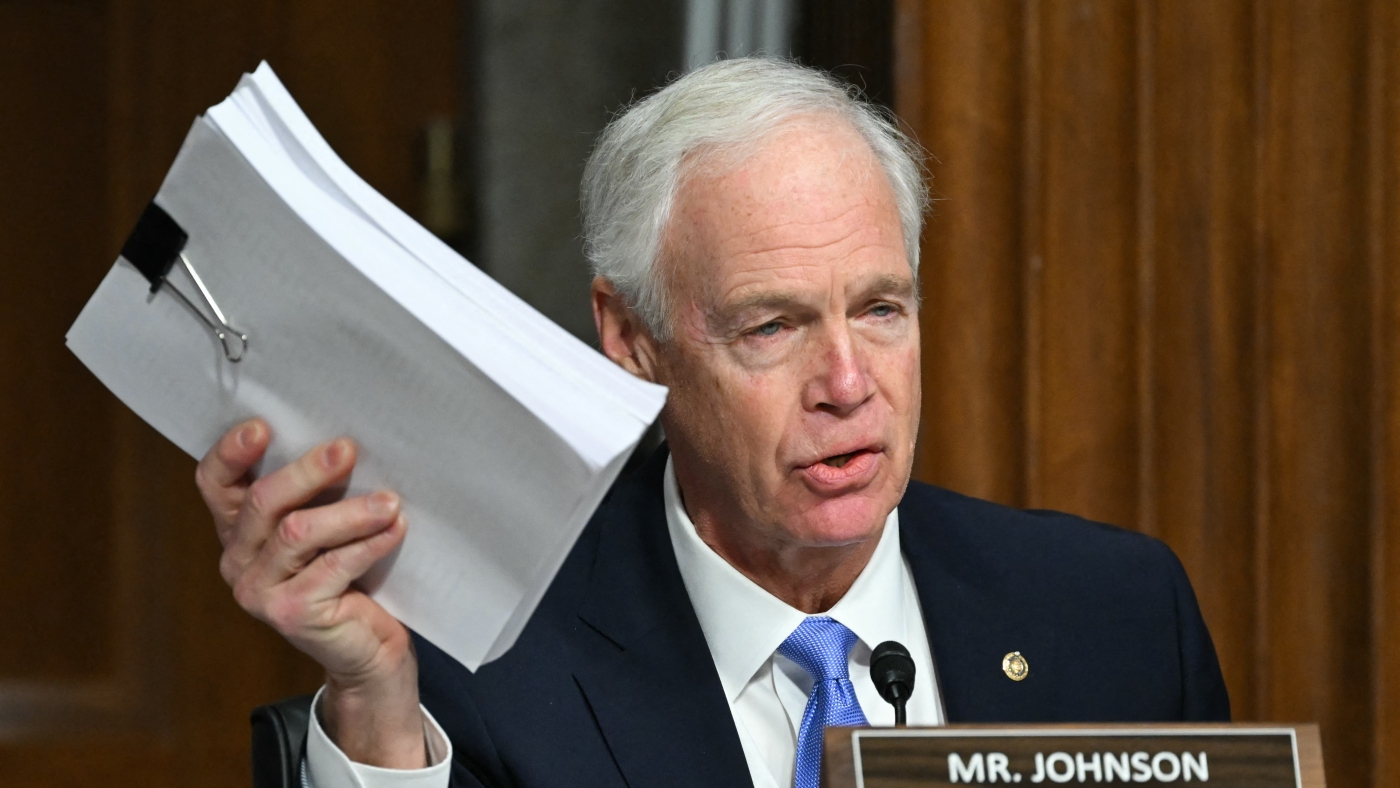
Wisconsin Republican Sen. Ron Johnson referred to as the Home finances plan a “unhappy joke.” He and different Senate Republicans are already elevating questions concerning the laws, even earlier than the Home finalizes their work.
Andrew Caballero-Reynolds/AFP/Getty Photos
disguise caption
toggle caption
Andrew Caballero-Reynolds/AFP/Getty Photos
As Home Speaker Mike Johnson, R-La., feverishly works to finalize the small print of an enormous bundle that features main parts of President Trump’s agenda, many Senate Republicans are dismissing the laws earlier than it’s even completed within the Home.
“Sadly, it is a unhappy joke,” Wisconsin GOP Sen. Ron Johnson mentioned Wednesday
“Wimpy,” and “anemic” have been the phrases Sen. Rand Paul, R-Ky., used to explain the spending cuts within the proposal.
The Home bundle, which the speaker nonetheless says he desires to advance via the chamber earlier than the Memorial Day recess, goals for $1.5 trillion in spending cuts to offset the prices of constructing the 2017 Trump tax cuts everlasting. It additionally comprises tax breaks that Trump campaigned on in 2024 — no taxes on suggestions and time beyond regulation — however these provisions are momentary.
Some conservatives within the Home are pushing for $2 trillion in cuts– however that is not far sufficient for Johnson who desires spending ranges to revert again to what they have been pre-pandemic. Sen. Johnson advised reporters that he believes it was a mistake for leaders to attempt to cross a lot of Trump’s agenda in a single single invoice, as an alternative of three separate items of laws that could possibly be thought of individually. In consequence, he mentioned he’d oppose the Home invoice “because it’s at present constructed.”
Different opponents embrace Sen. Josh Hawley, R-Missouri, who has been a vocal critic of the Medicaid program adjustments Home Republicans have proposed. He publicly rebuked fellow Republicans’ efforts to restructure the well being care program for low-income, aged and disabled in a recent editorial published in the New York Times.
Hawley particularly opposes including co-pays for some Medicaid recipients and freezing state taxes on hospitals that assist enhance how a lot federal cash goes to rural hospitals as objects which can be non-starters.
“I am not going to help this invoice from the Home, on this type. I believe it is clear it is received to alter earlier than it may well cross the Senate,” Hawley told CNN on Wednesday.
An opportunity for the Senate to make adjustments
One answer could possibly be for Senators to place their very own stamp on regardless of the Home passes.
“It is a good begin,” Sen. John Cornyn, R-Texas, mentioned Wednesday.
Cornyn advised NPR he expects the Senate guidelines will influence the ultimate model of the invoice. Republicans are utilizing a function of the finances course of often called reconciliation to advance the laws with out the specter of a filibuster by Senate Democrats — however that course of has particular guidelines and procedures.

“I am assured the Senate can have its personal concepts and we’ll cross a invoice right here which will differ some from the Home however then in the end must work out the variations,” He mentioned.
Cornyn did not weigh on his GOP Senate colleagues’ criticisms on numerous items of the Home invoice, saying, “I am extra serious about saving the American folks from a multi-trillion greenback tax improve.”
New York Rep. Nick LaLota advised reporters “dozens” of his fellow Home Republicans have advised Speaker Johnson they’re fearful they’ll vote for a bundle that’s disregarded by the Senate.
“These members are insisting that both the Senate go first or the Senate and the president bless off no matter invoice that we’re in the end requested to vote on.” LaLota mentioned.
He pointed to the expertise in 2017 when some Republicans in Congress on the time backed a invoice and felt burned after Trump later referred to as the proposal “imply.”
LaLota is a part of a bunch negotiating with the speaker to revive a tax break dubbed “SALT” that enables their constituents to deduct extra of their state and native taxes. However any transfer to extend the cap on the SALT deduction will add to the general price ticket of the invoice.
The problem of that deduction, which impacts largely blue states, is not a serious concern amongst Senate Republicans.
Sen. Paul additionally mentioned he opposed the Home invoice’s provision to raise the nation’s borrowing authority by $4 trillion, “I am not for growing the debt ceiling 4 or 5 trillion [dollars] — I am for balanced finances, restricted constitutional authorities, so I am simply not for that.”
