

British forces cost crowds throughout bread riots in Manchester, England, in 1819. The occasion grew to become referred to as the Peterloo Bloodbath, when troops had been ordered to disperse the crowds.
Rischgitz/Getty Photos
disguise caption
toggle caption
Rischgitz/Getty Photos
MANCHESTER, England — Within the middle of this industrial metropolis in northern England, a memorial commemorates protesters killed right here at an indication for employees’ rights in 1819, in what grew to become referred to as the Peterloo Massacre. The British cavalry charged at employees who had gathered to demand political illustration, killing a minimum of 18 folks and injuring a whole lot.
On the monument to these killed, arrows level outward to Pennsylvania, the place unarmed strikers had been killed on the Lattimer mine in 1897, and to South Africa, the place peaceable protesters had been killed at an anti-apartheid rally in Sharpeville in 1960.
What hyperlinks these locations is a shared historical past of employees’ struggles and other people’s uprisings around the globe. The monument just isn’t the one factor placing Manchester on the middle of this lengthy custom.
These days, politicians from across the political spectrum, from america to the UK and plenty of international locations around the globe, scramble to enchantment to working folks, however discussions concerning the political energy of the working class first gained prominence in Nineteenth century Britain. That is the place, through the Industrial Revolution, a brand new city working class was shaped and got here collectively to demand rights and illustration. Nowhere was this extra evident than in Manchester.

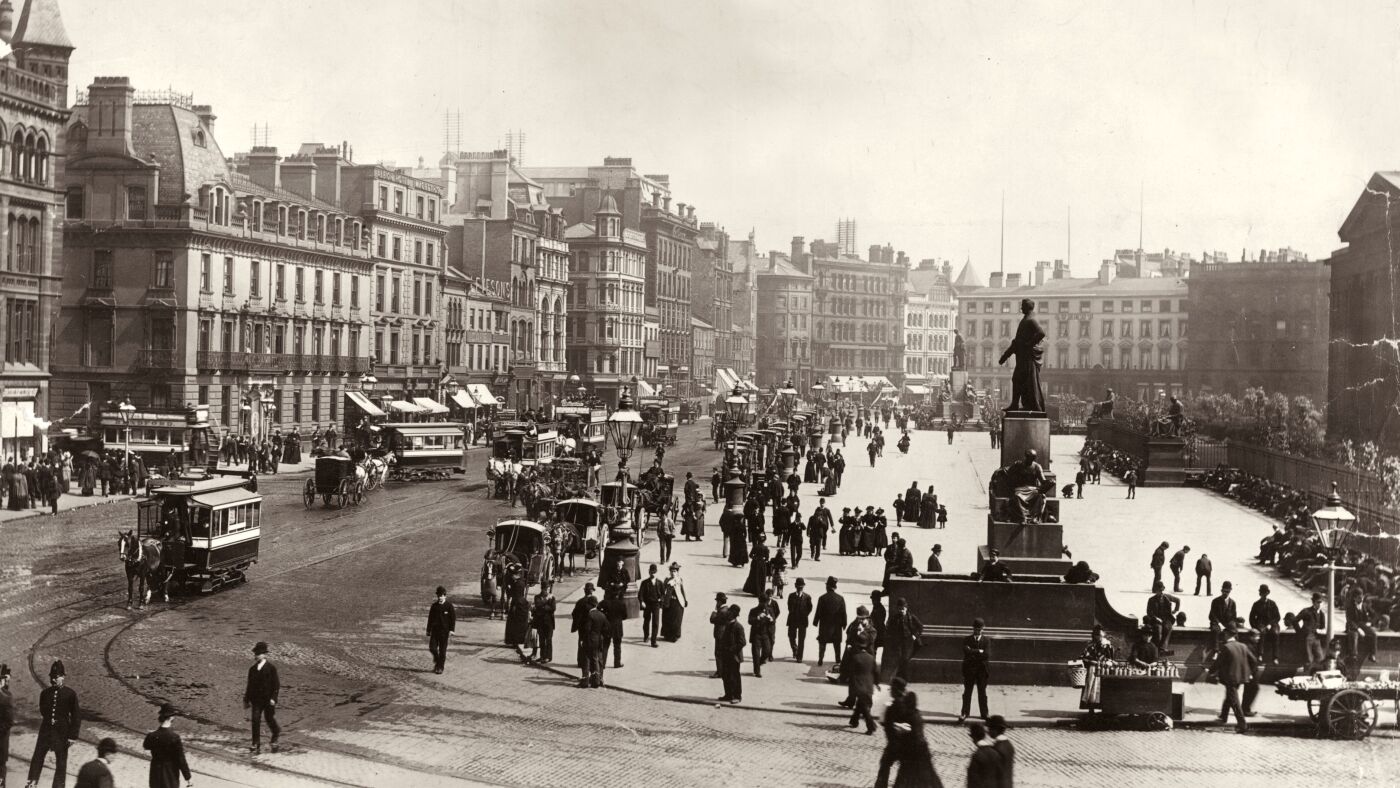
Individuals and horse-drawn carriages are seen in Manchester circa 1880.
Francis Frith/Getty Photos
disguise caption
toggle caption
Francis Frith/Getty Photos
The world’s first industrial metropolis
Manchester was the world’s first modern industrial city, and its city working class — and the abysmal circumstances they had been residing in — impressed the theories of German philosophers Friedrich Engels, who lived within the metropolis for 20 years, and his buddy and collaborator Karl Marx.
Engels wrote concerning the emergence of this group of laborers in his 1845 guide, The Situation of the Working Class in England. In it, he describes “the working-men’s dwellings of Manchester” as being so horrible that “solely a bodily degenerate race, robbed of all humanity … may really feel comfy and at residence.”
“Manchester turns into a logo for the working courses” within the 1800s, says Charlotte Wildman, a historian on the College of Manchester.
Town’s political significance continues to reverberate around the globe in the present day.
Manchester’s fast industrialization and the start of employees’ actions
Within the early Nineteenth century, Manchester grew to become the center of the world’s cotton commerce. The demand for cotton items as a part of the trans-Atlantic slave trade performed a key position within the fast industrialization of town. Agricultural employees from throughout Britain moved there to work.

Cotton mills on Union Road in Manchester in 1850.
Rischgitz/Getty Photos
disguise caption
toggle caption
Rischgitz/Getty Photos
“There wasn’t actually wherever for them to dwell,” Wildman explains. “There have been excessive ranges of poverty, sickness and ailments.”
On the identical time, the Industrial Revolution was making some folks rich. The massive wealth hole fueled resentment and calls for for higher circumstances.
“That very seen sense of wealthy and poor provides this new city working class a transparent identification and a way of oppression,” Wildman says.
Staff weren’t allowed to vote. These in energy had been reluctant to offer working males the vote as a result of they did not belief them, she says.
“They had been attempting to maintain away the lads that they noticed as undesirable, significantly the type of males who they deemed as prison or feckless,” she says. Girls of any class weren’t even thought-about as deserving of the franchise.
However working-class movements started to assemble tempo all through the Nineteenth century, progressively profitable over some rights for these new city employees — though universal suffrage for males in the UK didn’t occur till World Warfare I, in February 1918. The 1918 Illustration of the Individuals Act gave some ladies the fitting to vote for the primary time too — however solely these over 30 who owned a home or had been married to a home-owner. Girls didn’t achieve universal suffrage till 1928.
Marx and Engels in Manchester

German thinker Friedrich Engels circa 1860.
Amsler & Ruthardt/Edward Gooch Assortment/Getty Photos
disguise caption
toggle caption
Amsler & Ruthardt/Edward Gooch Assortment/Getty Photos
Nineteenth century thinkers flocked to Manchester to chronicle the working class, together with Engels and Marx.
Engels moved to Manchester in 1842, at age 22, to handle his father’s cotton factory on town’s outskirts. “Engels lived in Manchester for 22 years and Marx visited him there for months at a time,” says Manchester-based author John Schofield.
Engels’ father had despatched him to work on the household’s manufacturing unit there “to rid him of his excessive political opinions,” says native historian Ed Glinert, who provides strolling excursions of the German philosophers’ previous haunts across the metropolis. “His father mentioned a correct job on the household agency in Manchester would make him drop all of the politics and develop into a superb citizen.”
In reality, town had the alternative impact on him.
“Friedrich Engels walked into a really febrile state of affairs in Manchester in 1842,” says Schofield.
There had simply been a riot of millworkers within the metropolis and unrest and protests continued all through the 1840s. Engels even believed they could result in revolution within the metropolis.
Engels and Marx would work collectively at a desk within the metropolis’s Chetham’s Library, writing about employees and sophistication battle.

German thinker Karl Marx circa 1866.
Hulton Archive/Getty Photos
disguise caption
toggle caption
Hulton Archive/Getty Photos
The small picket desk within the library studying room is “one of the vital vital desks within the historical past of the world,” Schofield says. Drafts of the Communist Manifesto and Das Kapital (Capital) had been written at that desk, he says, with Marx sitting at one finish and Engels on the different.
Historian Wildman says the struggling the philosophers witnessed proper on their doorstep helped form their concepts.
“Marx and Engels would actually look out of the window of Chetham’s Library the place they had been writing and see this large quantity of poverty and other people struggling,” she says.
Though Engels continued to suppose a revolution may occur in Manchester, in the long run, it by no means did. However what was occurring within the metropolis was linked to and impressed different movements occurring within the mid-Nineteenth century in Europe.
“There have been waves of rebellions all through Europe within the mid-Nineteenth century,” Wildman says. “Individuals had been choosing up on related processes and on the will to have higher requirements of residing.”
Politicians started to concentrate, too.
“What Engels and Marx did was flip the working class right into a political commodity,” says native historian Glinert. “For the primary time, there was a category evaluation of society which individuals hadn’t actually considered prior to now.”
The worldwide battle for employees’ rights, from Manchester to Pennsylvania
In Manchester’s People’s History Museum, devoted to working-class historical past, the world’s oldest-surviving commerce union banner hangs alongside posters linking worldwide employees’ struggles from the Nineteenth century to the current day.
What started in Manchester with an 1819 bloodbath of peasants gave delivery to the world’s first employees’ actions, trade unions and an thought of equality that has fueled social justice and labor actions around the globe.
The museum charts a historical past of worldwide solidarity with employees that began in Manchester and that has reverberated via political discourse ever since.
