

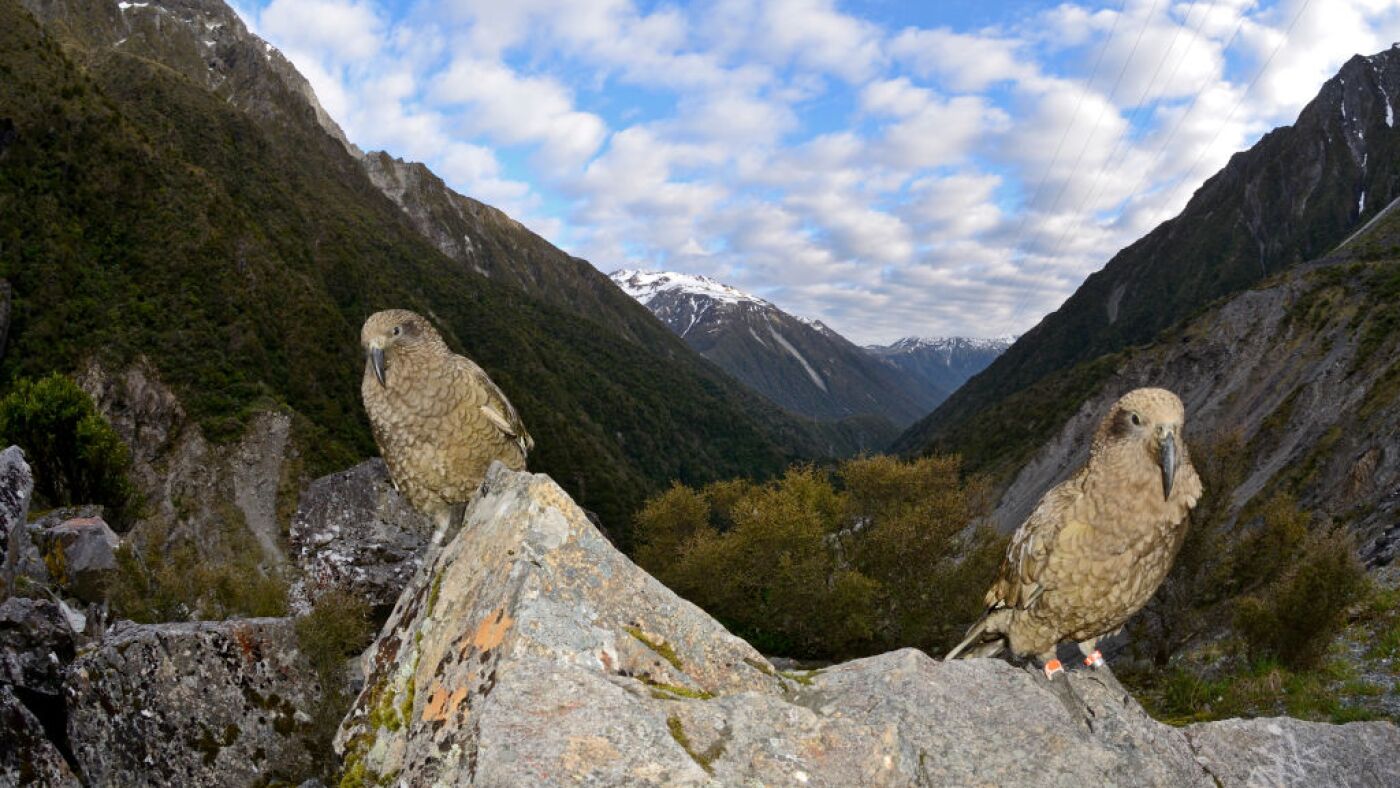
Two Kea birds, Arthurs Go South Island New Zealand. The species is listed as threatened in that nation and local weather change is among the many causes their numbers are in peril.
Schooling Photographs/Common Photographs Group through Getty/Common Photographs Group Editorial
conceal caption
toggle caption
Schooling Photographs/Common Photographs Group through Getty/Common Photographs Group Editorial
To think about how local weather change may trigger some extinctions, think about a tiny mountain fowl that eats the berries of a specific mountain tree.
That tree can solely develop at a selected elevation across the mountain, the place it is advanced over millennia to thrive in that microclimate. As world temperatures rise, each the tree and the fowl can be compelled to rise too, monitoring their microclimate because it strikes uphill. However they will solely go up to now.
“Ultimately, they attain the height, after which there’s nowhere else to go,” says Mark Urban, a biologist on the College of Connecticut.
Scientists name this mountain phenomenon the “escalator to extinction” and it is only one method local weather change is already squeezing crops and animals from their habitats. Researchers have carried out a whole lot of research projecting how totally different species may reply to totally different ranges of local weather change, discovering various outcomes. In an analysis published Thursday within the journal Science, City sought to carry all these research collectively.
“I wished to get a greater general image, to offer a solution to resolution makers who wished to know precisely how local weather change would translate into extinction threat,” he says. That image is worrisome, he discovered, particularly at increased ranges of warming.
“Every of those species has encountered and solved life’s issues. They’re actually the good books of information on Earth,” says City. “We actually do not wish to burn these books earlier than we get an opportunity to learn them.”
If nations meet the shared objective of limiting warming to 1.5 levels Celsius, 1.8 % of species can be susceptible to extinction by the tip of the century, City studies. But when world warming will get out of hand, warming 4 or 5 levels Celsius, as many as 30% of species may very well be in danger.
“That 30 % is perhaps the most effective case state of affairs of the worst case state of affairs,” says Cristian Román-Palacios, a organic information scientist on the College of Arizona who wasn’t concerned within the examine.
He factors to confounding complexities in how species may reply to such local weather extremes that scientists do not but know. Extra critters might merely not be capable of cope, or ecosystems that lose species after species might collapse altogether. Moreover, many uncommon species are understudied, or not even found, and is perhaps particularly weak in ways in which do not present up on this evaluation.
Nonetheless, “we want broad-scale research like this,” says John Weins, an evolutionary biologist on the College of Arizona. “If we wish to cease the lack of biodiversity, we have to know what the threats are.”
In lots of cases, stopping biodiversity loss means preserving their pure habitats, by protected areas or nationwide parks. That will not essentially work for saving species from local weather change, says Weins.
“You may defend every part, you may cease all of the destruction of rainforests, get every part in preserves, and you can nonetheless lose one third of species on Earth,” he mentioned. “It requires a extra world answer, when it comes to stopping carbon emissions.”
The globe has already warmed by about 1.3 levels Celsius from the preindustrial common, which might tip about 1.6 %of species in the direction of extinction by 2100, City discovered. If emissions proceed at their present trajectory, about one in twenty may blip out of existence. Past that, threat actually accelerates, underlining the necessity for local weather motion, he says. At a extra excessive state of affairs of 4.3 levels of warming, almost 15 % of species can be imperiled. And at 5.4 levels of warming, 29.7 % of species may die out.
Completely different species face some totally different dangers. Amphibians, together with frogs and salamanders, are extra weak, City discovered, maybe as a result of their habitats are extra delicate to environmental adjustments. Species that stay on islands, mountains and in freshwater may face extra challenges, too. Focused conservation efforts may assist sluggish losses, City says, however they’re in the end no substitute for decreasing emissions.
Scientists have described roughly 2 million species, however that is seemingly only a fraction of the biodiversity the planet helps. Estimates range extensively, however converge on one thing like 10 million species. In response to City’s evaluation, that might imply the planet is already on monitor to lose about 160,000 species, and will see almost 3 million disappear below the worst-case state of affairs.
“The examine presents a transparent option to resolution makers,” says City. “Will we curb emissions now and work to guard that 2% of species which might be at present in danger? Or will we select one in all these different paths that may essentially alter the character of our world?”
